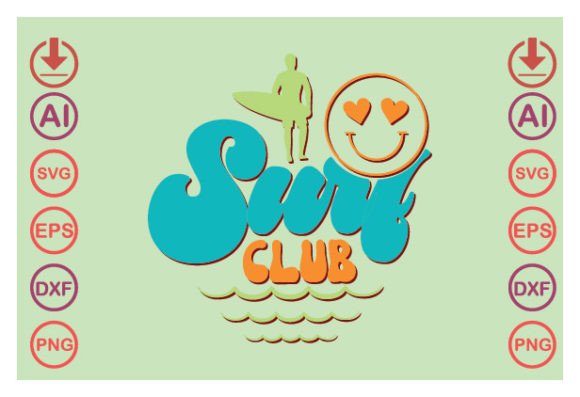
Surf Club Embroidery Design Review
A First Look at Surf Club
At first glance, Surf Club feels like a design that’s been crafted with a specific vibe in mind. The wave motifs and beachy iconography immediately evoke a sense of laid-back summer fun. It's the kind of design that makes you think of coastal towns, sunsets, and carefree days by the water. The layout is balanced, with enough detail to feel intentional but not overwhelming. This makes it a great candidate for a variety of embroidery projects, especially those that aim to convey a relaxed, casual aesthetic.
The visual personality of Surf Club is playful yet refined. It has a clean, modern look that would work well on both simple and more intricate fabric backgrounds. I can see this design fitting nicely on a custom embroidered tote bag or even a baby onesie with minimal additional embellishment. Its versatility is one of its strongest points, and it’s easy to imagine how it might be adapted for different audiences and purposes.
How Surf Club Performs in Real Projects
When considering how Surf Club performs in real-life embroidery situations, I tested it out on a few different materials. On a standard cotton t-shirt, the design stitched up beautifully. The wave patterns had a nice flow, and the details were crisp and clear. The use of satin stitch and fill stitch gave the design a polished finish that felt professional and well-crafted.
I also tried it on a canvas tote bag. Here, the design maintained its clarity, though I noticed that on a thicker fabric, the stitch density became slightly more pronounced. This isn’t necessarily a bad thing—it just means that Surf Club works best when paired with appropriate stabilizers and thread colors. A light gray or white stabilizer helped keep the design from puckering, which is always a concern when working with heavier fabrics.
For a more personal touch, I experimented with using Surf Club on a baby onesie. In this case, the design was scaled down and placed near the hemline. The result was charming and age-appropriate, without being too busy. It was a subtle nod to the beach theme, perfect for a personalized gift or small shop product.
Another interesting application was on a pillow cover. Here, the design stood out against the neutral background, adding a pop of character to the room. The stitching remained consistent, and the overall look was cohesive and visually appealing. This shows that Surf Club can be used across a wide range of items, from custom apparel to home decor.
Where to Use Surf Club with Caution
While Surf Club is versatile, there are certain situations where it should be used carefully. For instance, on small hoop sizes, the design may lose some of its visual impact. The fine details in the wave patterns could become less defined if the hoop is too small. It’s important to check the recommended hoop size before proceeding, as this will affect the final outcome.
On textured or stretchy fabrics, the design may not lay as flat, so using the right stabilizer becomes essential. Similarly, when placing Surf Club on dark fabric, the thread color contrast needs to be considered. Light-colored threads may not stand out enough, while darker threads could overpower the design. Testing on scrap fabric first is always a good idea to ensure the finished product looks exactly as intended.
When using Surf Club on curved surfaces, such as caps or hats, the placement and scaling need to be precise. Otherwise, the design may appear distorted or misaligned. This is especially important for commercial embroidery projects, where consistency and quality are key to maintaining customer trust and brand recognition.
Design Notes for Embroidery Professionals
If you're planning to use Surf Club in your next project, here are a few practical tips:
- Test on scrap fabric: Always do a test run to see how the design stitches up on your chosen material.
- Check thread color contrast: Make sure the thread color complements the fabric and enhances the design.
- Review stitch density: Adjust the stitch density if needed to avoid overcrowding or under-stitching.
- Confirm hoop size: Ensure the hoop size matches the design dimensions to prevent distortion.
- Inspect small details: Zoom in on the digital file to make sure all elements are clearly defined.
- Test in black and white mockups: This helps assess how the design will look on different fabric backgrounds.
- Use proper stabilizer: Especially on thick or stretchy fabrics, a good stabilizer ensures the design lays flat and stays in place.
- Confirm licensing: Before selling any finished products or digital assets, make sure you understand the licensing terms.
Surf Club is a solid addition to any embroidery designer’s toolkit. Whether you're creating handmade products, personalized gifts, or commercial embroidery projects, this design offers a unique blend of style and functionality. With the right preparation and attention to detail, it can elevate your work and bring a fresh, beach-inspired look to your creations.